The Collapse of Meaning and the Work of Repair
There are moments when the structures that once held your life together begin to loosen.
Not dramatically, at least not at first. It’s subtler than that. A thinning. A slight misalignment between the story you’ve been living inside and the experience of actually living it. Things still function, externally. But internally, something has shifted. The coherence isn’t what it was.
And what’s unsettling is that this doesn’t necessarily feel like something has gone wrong. It can feel closer to something becoming visible.
This is where the conversation around meaning often becomes too simplified. We tend to talk about meaning as something we either have or lack, as though it were a stable property of a life well-constructed. But if Becker is right—and I think he largely is—then what we call meaning is better understood as a kind of psychological structure. It stabilizes us. It gives orientation. It situates our actions within a larger frame that feels continuous and enduring.
But that structure is never fixed.
It holds until it doesn’t.
Becker’s broader claim, particularly in The Denial of Death, is that these structures exist in part to buffer us from the full psychological impact of mortality awareness. They allow us to function without being constantly overwhelmed by the knowledge that our lives are finite and, at least from a cosmic perspective, fragile. Culture, identity, even our most personal commitments—these are not neutral. They are stabilizing systems.
Which means they are also vulnerable.
When they begin to fail, what returns is not just confusion. It is exposure.
What emerges first is often disorientation. A difficulty locating yourself within the frame you once inhabited without effort. But underneath that is something more fundamental: the re-emergence of mortality anxiety. Not always as panic or fear, but as a persistent pressure. A background awareness that has moved forward.
It’s important to be precise here. What collapses in these moments is not simply happiness or motivation. It’s coherence. The sense that your life fits into something that extends beyond you. The sense that your actions carry weight within a larger continuity.
When that disappears, the problem is not reducible to mood. It’s structural.
This is where Becker’s idea of the “hero system” becomes particularly useful. A functioning worldview allows you to experience yourself as someone who matters within a world that persists. It provides a sense of symbolic durability. When that system weakens, the individual is not just left feeling bad. They are left without a stable position from which to experience themselves as meaningful.
That distinction is important.
It also helps explain why existential collapse is so often misread. It is easy to collapse it into the language of depression, but the two are not identical. Depression can drain energy, flatten affect, and reduce engagement. Existential collapse removes something else entirely, the justification for engagement.
You can still act. You can still function. But the underlying reason for doing so becomes unclear.
At the far edge of this, something more difficult can emerge. Not necessarily a desire to die, but an inability to continue within the absence of structure. Awareness becomes too direct. Too constant. What had been buffered becomes immediate.
Otto Rank’s contribution is useful here. For Rank, anxiety itself is not the problem. It is the condition of being human. The problem arises when anxiety cannot be transformed, when it has nowhere to go. In the absence of a functioning symbolic structure, it does not convert into work, relationship, or form. It accumulates.
From Becker’s perspective, this is a collapse of heroism. The individual no longer experiences themselves as capable of generating meaning that holds.
So what happens next?
In most cases, one of two responses emerges.
The first is an intensification of defense. People double down on existing structures. They move toward rigidity, certainty, or ideological reinforcement. The aim is not necessarily truth, but stability. The structure must hold, even if it becomes narrower.
The second is a drift toward nihilism. If no structure feels believable, the system can collapse inward. Motivation erodes. Engagement withdraws. The absence of meaning becomes the dominant frame.
Neither response resolves the underlying condition. They manage it.
But there is a third possibility, though it is less immediate and far less comfortable.
It begins, not with clarity, but with grief.
Ross and Rachel Menzies make an important observation here in Mortals. They frame grief not simply as a reaction to loss but as one of the earliest forms of meaning-making available to us. When the symbolic world fractures, grief is the process through which it begins, tentatively, to reorganize.
This is not resolution. It is a form of metabolization.
Ritual plays a role here as well. Not because it solves the problem of death, but because it provides a container within which meaning can begin to reassemble. Importantly, this is rarely an individual process. Meaning, at this level, is reconstructed relationally.
This is also where I find a direct connection to creative practice.
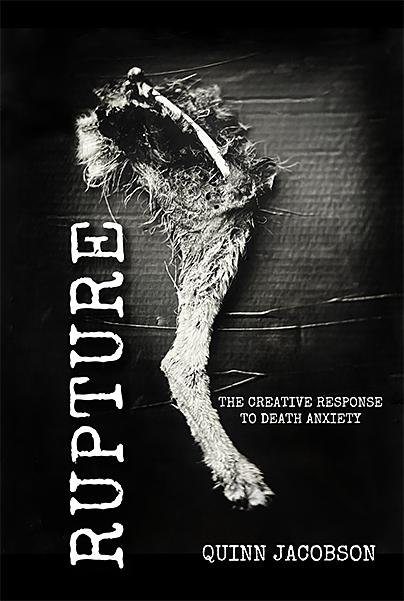
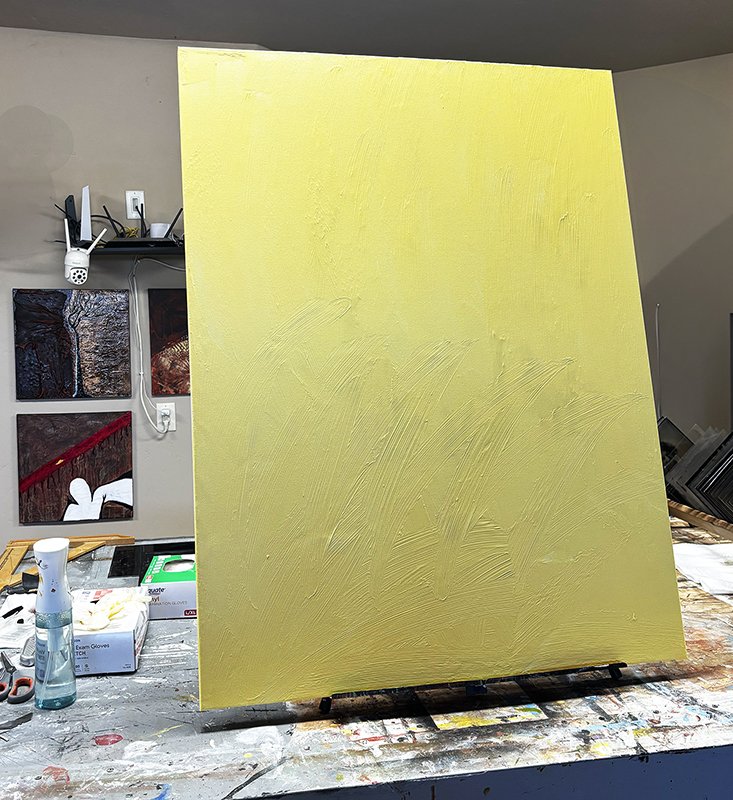
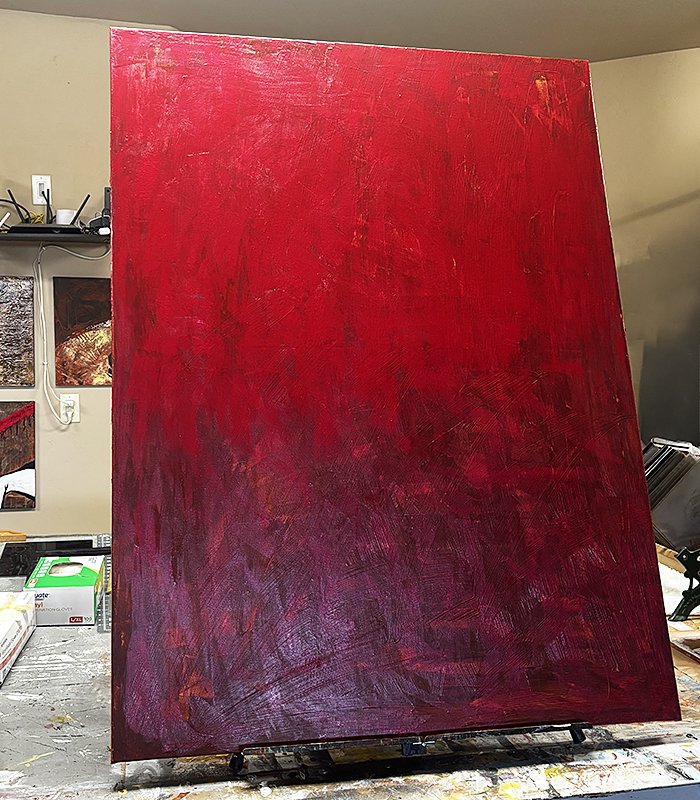
Some of the most important work I’ve made has not felt like expression in any conventional sense. It has felt closer to mourning. A slow, often resistant attempt to give form to something that does not yet have one. The work does not explain the rupture. It holds it.
That distinction seems increasingly important.
If we extend the philosophical frame further, this position sits in a kind of tension with Schopenhauer and Camus. For Schopenhauer, suffering is not a disruption of life but a fundamental condition of it. From that perspective, collapse is not an accident. It is what happens when illusion thins.
Camus, working from a different angle, identifies the problem as the gap between our need for meaning and the world’s refusal to provide it. The absurd emerges from that mismatch. His response—what he calls revolt—is not a solution but a stance. A decision to continue participating without resolving the contradiction.
That position, I think, comes very close to what Becker identifies in the artist.
The artist does not escape the condition. They remain exposed to it. What differs is the capacity, or perhaps the compulsion, to work with what is there rather than around it. To take in fragmentation, impermanence, contradiction—and to give it form.
Not to resolve it.
To hold it.
Peter Wessel Zapffe pushes this even further. His argument, that human consciousness may have overshot its evolutionary function, reframes the problem entirely. The issue is not simply collapse. It is that we are capable of seeing too much without having the structure to sustain it. His metaphor of the Irish elk—an organism whose evolutionary development became its liability—remains difficult to dismiss.
Awareness, in this sense, is both the source of meaning and the condition of its instability.
Which brings us back to the central question.
If collapse is not incidental, but structural, what do we do with it?
Becker’s answer is restrained but significant. A minority of individuals do something different. They do not fully retreat into defense, and they do not entirely collapse into despair.
They create.
Not as distraction or denial. It’s a way of metabolizing what they are encountering.
This is where the idea of repair becomes useful.
Repair is not a return to a previous state. It is a reconstruction that acknowledges the fragility of its own foundation. It does not attempt to eliminate uncertainty. It builds with it.
That process is slow. It is often unclear. And it rarely feels like progress in any conventional sense.
But something does shift.
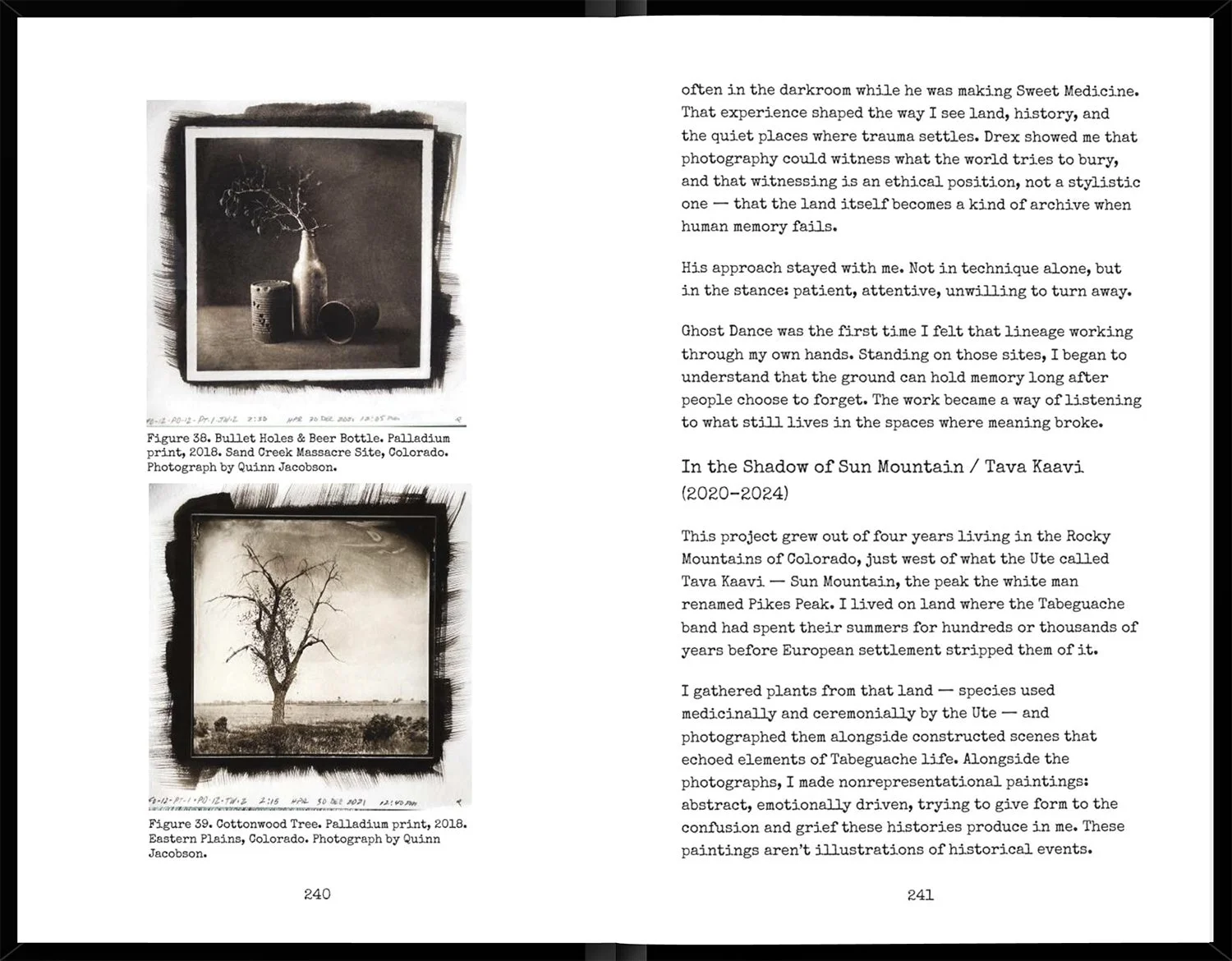
In the studio, this shift can be almost imperceptible. Watching an image emerge in the darkroom, there is a moment where something that was not visible begins to take form. It does not solve the underlying tension. But it changes your relationship to it. You move, however slightly, from being inside the pressure to witnessing it.
That movement matters.
It is, I think, what allows the process to continue.
There’s a line from Mike Doughty that I’ve been holding onto: How can I do it? I can’t not.
It doesn’t read as resolve. It reads as necessity.
And that may be the most honest position available.
Creation, in this sense, is not always a choice grounded in clarity or purpose. It is often what remains when the alternative—complete withdrawal—becomes untenable.
The collapse of meaning is not a failure of the individual.
It is a condition of being aware.
The question is not whether it happens.
The question is whether we can remain with it long enough to build something that does not require us to look away.
Repair begins there.
And for some of us, it continues in the work.