• blog
  • in the shadow of sun mountain
  • buy my books
  • photographs
  • paintings
  • bio
  • cv
  • contact
  • search
Menu

Studio Q Photography

Exploring Human Behavior and Death Anxiety Through Art
  • blog
  • in the shadow of sun mountain
  • buy my books
  • photographs
  • paintings
  • bio
  • cv
  • contact
  • search
×

“The Outline and the Drift,” half-plate tintype.
February 5, 2026 Las Cruces, New Mexico

The Outline and the Drift

Quinn Jacobson February 5, 2026

I made this image today using a dead bird mounted on black-painted cardboard, then worked around the body rather than on it. The decision felt important. I didn’t want to manipulate the bird into meaning or turn it into a symbol that behaved too neatly. I wanted to acknowledge the body as it was and let my response happen in the space around it. The marks I painted loosely reference feathers, but only in the most unstable sense. They’re not meant to describe anatomy. They’re an attempt to register something leaving the body at death, not as transcendence or ascent, but as dispersal. Whatever animates a living being doesn’t depart cleanly. It destabilizes. It lingers as a trace.

I was also intentionally playing with the visual language of a chalk outline, the kind left at a crime scene. That gesture carries a particular cultural weight. A chalk outline is an attempt to fix an event in place, to impose order after something irreversible has already occurred. It marks where a body was, not where it went. In this image, that outline sits in tension with the radiating marks around it. One gesture tries to contain the loss, to hold it still. The other admits that containment has already failed. Together, they stage a familiar human dilemma: the impulse to document death versus the fact that death resists explanation.

The contrast between the bird’s spanning wings and the surrounding painted “feathers” matters to me. The body is heavy, finished, and unequivocally still. The marks around it are directional but unresolved, interrupted, and uneven. They don’t form a halo. They don’t promise meaning. They reflect the lag that often follows death, the moment when the body has stopped but our perception hasn’t caught up yet. Meaning keeps moving even when life has ended. The image lives in that gap.

I’m not making a claim here about what death is or what leaves the body when it happens. I’m more interested in the human need to respond once stillness becomes unbearable. The marks don’t prove that energy exists. They mark the moment when we can no longer tolerate absence without gesture. For me, that’s where the work begins: not in explanation or consolation, but in staying with what remains unresolved and allowing the image to hold that tension without trying to seal it shut.

In Art & Theory, Arts-Based Research, Death, Experimental Collodion, Existentialism, Tintype, Wet Plate Collodion, PhD Tags PhD, Arts-Based Research, Tintype
Comment

Ruptureology

Quinn Jacobson February 4, 2026

“Some day soon, perhaps in forty years, there will be no one alive who has ever known me. That’s when I will be truly dead – when I exist in no one’s memory. I thought a lot about how someone very old is the last living individual to have known some person or cluster of people. When that person dies, the whole cluster dies, too, vanishes from the living memory. I wonder who that person will be for me. Whose death will make me truly dead?”
Irvin D. Yalom, Love’s Executioner and Other Tales of Psychotherapy

In Ruptureology Tags rupture, Rupturegenesis, Ruptureology
3 Comments

“Glasshead-Stoneman,” collodio-chloride printed on glass and backed with gold pigment,
Half-plate. January 30, 2026 Las Cruces, New Mexico for the book, Glass Bones (ABR)

Glass and Gold - Glass Prints

Quinn Jacobson January 31, 2026

This piece grew out of a technical curiosity, but it didn’t stay there for long.

I’ve been experimenting with collodio-chloride on glass, using a wet collodion half-plate negative as the source image. What interested me initially was the reversal: taking a process already defined by fragility and asking it to exist as an object rather than an image alone. Printing onto glass changes the relationship immediately. The photograph no longer sits on a surface; it hovers within one. It becomes something you look into rather than at. I’ve printed on glass before—carbon, oil, and collodio-chloride. This gold addition was new.

That shift matters to me. My work is often in the unstable space between presence and absence, between what can be held and what can't. Collodio-chloride amplifies that tension. The image is there, but it never fully settles. It feels provisional, as if it could just as easily slip away.

Exposed, pre-fix.

After the print was finished, I backed the glass with gold. That decision wasn’t decorative. Gold carries a long cultural history of sanctification, permanence, value, and transcendence. Gold is what we use to signify that something matters and endures. In this context, it felt closer to a defense mechanism. A thin layer of assurance applied to something fundamentally unstable. The gold doesn’t resolve the fragility of the glass or the image; it frames it and maybe even tries to protect it. That tension is the point.

I’m aware that backing photographic images with gold carries the history of the orotone, a process designed to heighten luminosity and permanence. I’m interested in that lineage, but not in reviving it. Here, the gold isn’t about brilliance or finish. It functions more like a psychological gesture, an attempt to stabilize what can’t be stabilized, to sanctify something that is already slipping.

The skull forms in the background weren’t meant to announce themselves. They emerge slowly, almost reluctantly. That’s how mortality functions most of the time. It isn’t usually dramatic or explicit. It sits behind us, watching, shaping our behavior without demanding our attention. I wanted that presence to feel ambient rather than symbolic, something you notice only after spending time with the image.

The central figure feels assembled rather than organic. Stacked. Held together. I think of it less as a subject and more as a structure, a self-constructed one under pressure. The translucence of the collodio-chloride allows it to exist somewhere between solidity and dissolution, which mirrors the psychological space I’m often working in. Identity here isn’t fixed. It’s maintained.

From an arts-based research perspective, this piece feels important because the process itself is doing the thinking. I’m not illustrating theory after the fact. The materials are pushing back. Glass breaks. Chemistry misbehaves. The image resists control. Those risks aren’t incidental; they’re where the knowledge lives. The work knows something because it could fail.

What consistently resonates with me is the delicate boundary between reverence and denial. The gold can read as a halo or a shield. I’m interested in that ambiguity. It reflects the way we often try to stabilize what we know is unstable—through meaning, through ritual, through objects that promise endurance.

This piece doesn’t try to solve anything. It holds a condition. It sits with fragility rather than sealing it over. That feels honest to me.

Much more exploring ahead! I might break these and see what that produces. And I’m in the process of getting some front-surface mirror material to experiment with; I mention the technique in my book to make “faux” daguerreotypes. I’m going to use collodio-chloride to see what happens.

In Collodio-Chloride Glass, Glass Bones Tags collodio-chloride on glass, Glass Bones
6 Comments

A Film You Should Watch

Quinn Jacobson January 28, 2026

What I appreciate most about Flight from Death is that it doesn’t reduce death anxiety to pathology. It shows how mortality awareness fuels everything from cruelty to creativity. For artists especially, this film lands hard. It raises the uncomfortable question of whether making is a way of hiding from death—or a way of facing it honestly.

If you’re interested in why art matters at all, start here.

Watch it slowly. Let it bother you a little. That’s kind of the point.

It’s on my Vimeo page: Flight From Death

In Flight From Death Film Tags Flight from Death: The Quest for Immortality
Comment

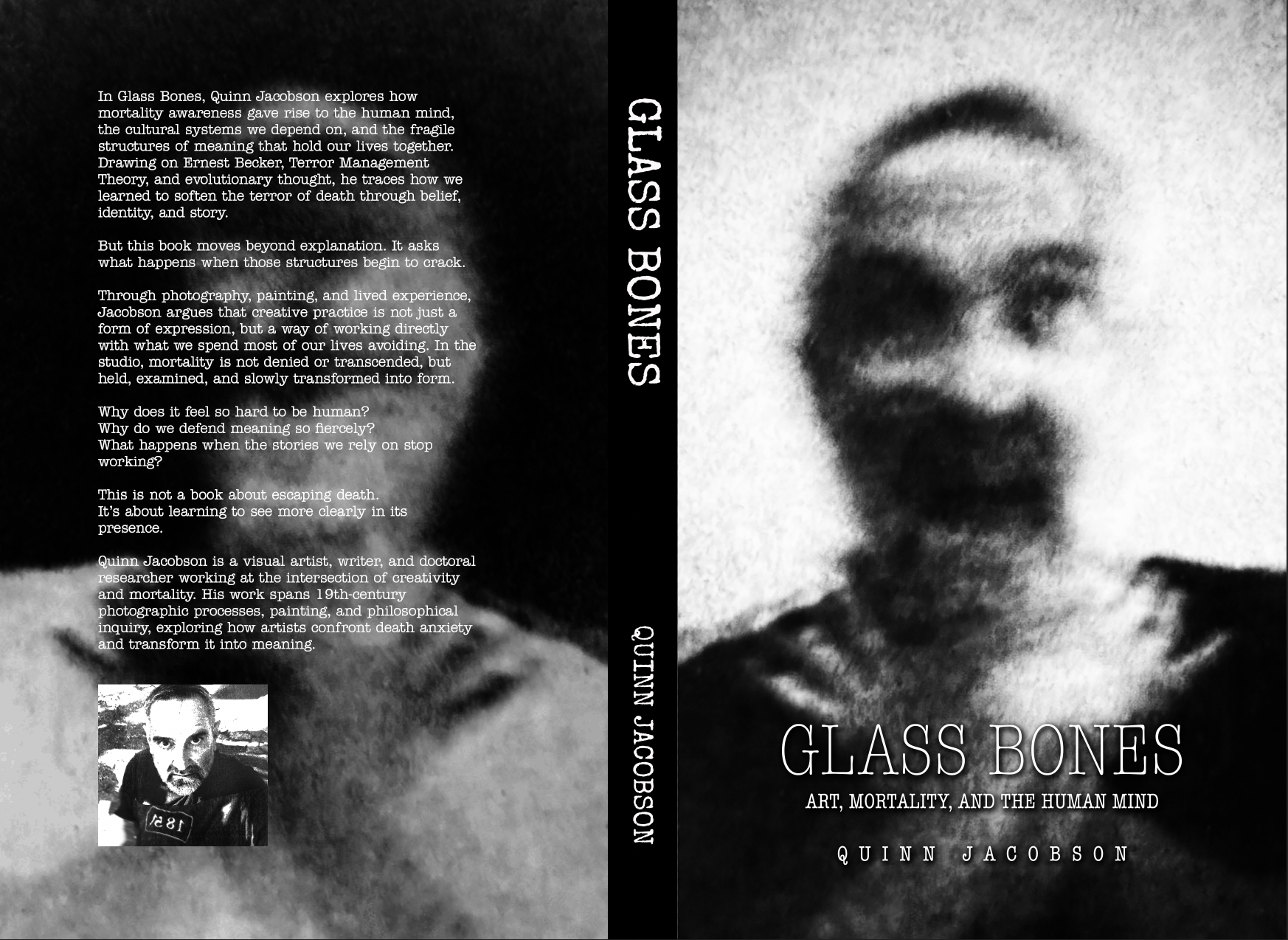
Mockup covers of my new books.

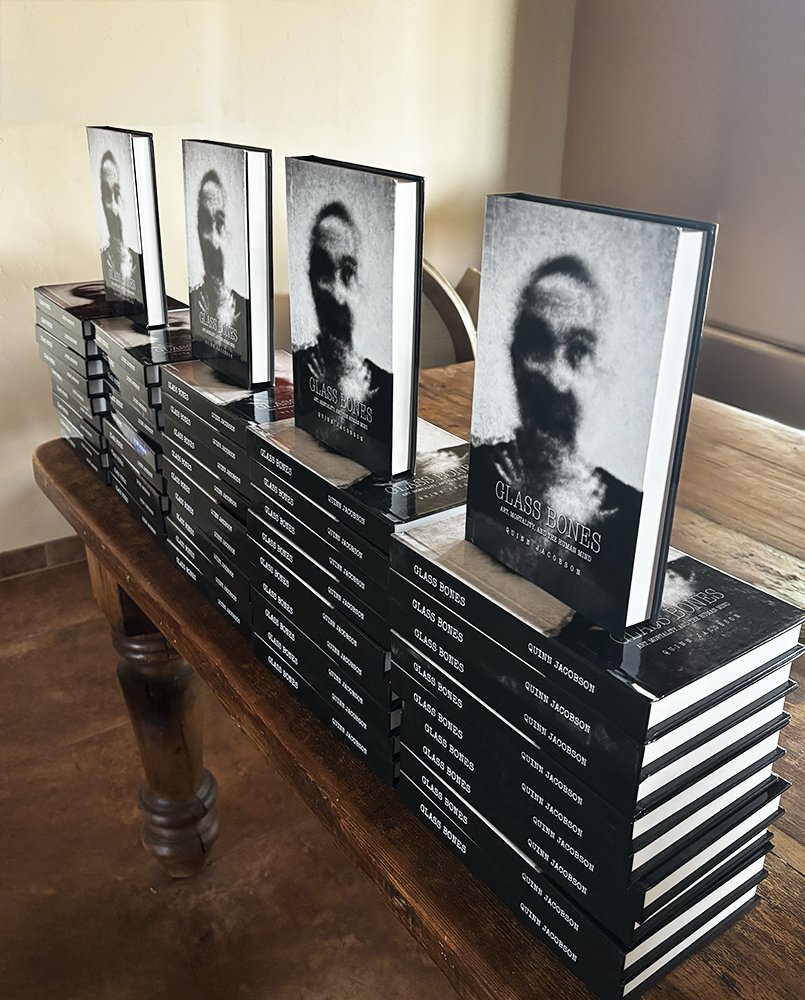
My New Books for 2026

Quinn Jacobson January 27, 2026

Have you ever had an epiphany? An epiphany is a sudden, profound realization or insightful moment where the true meaning or essence of something becomes clear, often from a simple occurrence, stemming from the Greek word for "manifestation" or "appearance.”

I’ve had several over the past few weeks.

I wanted to share how I’m going to unfold these publications this year. I will use some of the 800-900 pages of text in these books for my 2028 thesis/dissertation—these writings will drive my dissertation.

“I’m building a psychology of artistic practice that takes mortality seriously as a formative force. And my three books, Glass Bones, Rupture, and In the Shadow of Sun Mountain, act as a trilogy: Theory → Practice → Witness regarding the theories and creativity.”
— Quinn Jacobson

This is how I see it transpiring:

June 2026: Glass Bones is published.

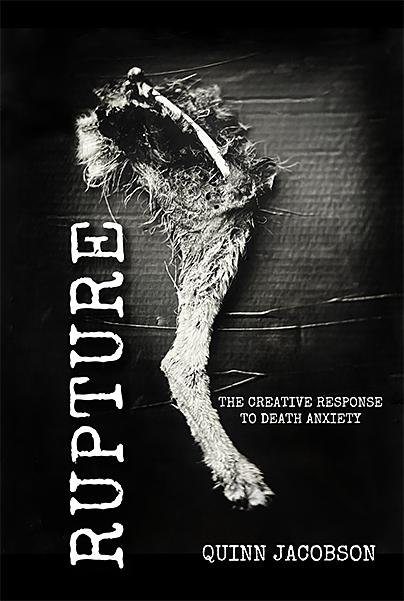
September 2026: Rupture is published.

November 2026: In the Shadow of Sun Mountain is published.

Allow me to explicate: I'm building a psychology of artistic practice that takes mortality seriously as a formative force—not as metaphor, but as the pressure that shapes how artists see, make, and live. My trilogy examines this from three angles: Glass Bones provides the theoretical framework, drawing on Becker, Rank, and Terror Management Theory to understand death anxiety and cultural defense. Rupture translates theory into practice, exploring the disciplines and orientations that allow artists to transform existential pressure into creative form. In the Shadow of Sun Mountain offers lived witness—thirty years of working with nineteenth-century processes, paint, clay, broken materials, plants, people, and the mountain landscapes as sites where mortality and imagination meet. Together, they map the terrain where awareness becomes art: Theory → Practice → Witness.

This research is situated within liminal space: psychological, material, and cultural thresholds produced by mortality awareness. Rather than resolving death anxiety through symbolic closure, the work asks what becomes possible when creative practice holds the threshold open long enough for transformation to occur.

Mortality awareness places me in a permanently liminal condition. I am alive, but never free of the knowledge that I will not remain so. From a Beckerian perspective, this is not incidental; it is the core destabilizing fact of consciousness. I am an animal capable of symbol-making who cannot fully believe in my own symbols, a being suspended between embodiment and abstraction, presence and disappearance.

I do not experience this condition as episodic or developmental, something to be outgrown or resolved. It is structural. Consciousness itself unfolds at the threshold. What culture often treats as pathology or anxiety to be managed, I understand as the ground from which meaning-making arises. Creative practice, in this sense, is not an escape from liminality but a way of inhabiting it with attention and responsibility, giving form to what cannot be stabilized without distortion.

I will be making new work—photographs, paintings, and mixed media for Glass Bones and Rupture. My work from the mountain will be featured in Sun Mountain.

I think you can wrap your head around that one, right? Just writing this out alleviates some of the “it’s in me, and it has to come out” stuff. To quote John Lee Hooker from Boogie Chillin’ (1948), a natural, internal force that must be expressed. 

In New Books 2026 Tags new books, PhD, Ruptureology, rupture, In the Shadow of Sun Mountain, Glass Bones
4 Comments

The Dimmer Switch Explained

Quinn Jacobson January 26, 2026
In Dimmer Switch, Pigment Printing, Anxiety, Consciousness, Death and Dying, Death Anxiety, Denial of Death, Ernest Becker Tags Dimmer Switch
Comment

“Holding Pattern,” 16” x 20” acrylic on canvas. January 23, 2026

Holding Pattern

Quinn Jacobson January 24, 2026

I made Holding Pattern without a clear image in mind. What I had was pressure. The sense that something was circling without resolution, asking to be held rather than explained. The painting emerged through accumulation and restraint. Layers were added, scraped back, and redirected. Each decision responded less to intention than to the condition the surface was already carrying. I wasn’t trying to resolve the image. I was trying to stay with it.

Materially, the surface itself is ruptured; cracked, weathered, and refusing integrity. The paint records its own breakdown. This isn't a representation of rupture; it's rupture as material fact. The painting embodies what it's examining by subjecting itself to the same forces of deterioration it's addressing conceptually. The medium becomes inseparable from the inquiry.

As arts-based research methodology, this is knowledge production through making rather than through language. I’m not illustrating a thesis about reproduction-as-death-denial that you arrived at discursively. I’m using paint, surface, gesture, and material breakdown to think through something that can't be fully accessed through writing alone.

The painting knows things my writing can't get to. It enacts the gravitational pull of the drive, the suffocation of the holding pattern, the way ideology fragments bodies even as it organizes them. The counterclockwise inward spiral isn't a metaphor I chose to represent an idea, it's a formal discovery that emerged through material engagement, and it carries meaning that exceeds paraphrase.

Arts-based research treats the artwork as primary data and the making process as an investigative method. The decisions I made; impasto that builds up and cracks, a spiral that compresses rather than expands, colors that register as bodily rather than symbolic, these aren't aesthetic choices decorating research findings. They are the research. The painting generates understanding about death anxiety, compulsion, and cultural reproduction (egg) that exists in formal and material relationships rather than in arguments.

The rupture also functions methodologically as refusal of traditional research's demand for coherence and resolution. Academic writing wants to arrive somewhere, to synthesize, to offer frameworks. The painting refuses. It stays with fragmentation, with irresolution, with the holding pattern itself. That refusal is epistemological; it insists that some truths about mortality and compulsion can only be approached through sustained engagement with what won't cohere.

What I’m doing is using the body's engagement with materials, the physical acts of mixing, applying, scraping, building, and watching paint crack, as a way to metabolize cultural and psychological forces that are otherwise difficult to grasp. The painting becomes a site where those forces can be witnessed and worked through without being explained away.

In ABR, Acrylic Painting, Art & Theory, Psychology, PhD Tags Holding Pattern, acrylic painting, 16x20
2 Comments

The Sacred Didn’t Vanish - It Migrated

Quinn Jacobson January 19, 2026

Any system that becomes the sole container for existential meaning will behave like a religion, including its pathologies.

That’s not a moral judgment. It’s a psychological observation.

We tend to talk about religion as something people either believe in or reject. But from an existential perspective, that framing misses what religion actually does. Religion isn’t primarily a set of supernatural claims. It’s a symbolic system that helps human beings orient themselves inside chaos. It answers questions we cannot avoid but cannot solve: Why am I here? What matters? How should I live? What do I do with suffering? What happens when I die?

From a Beckerian and Terror Management Theory perspective, those questions are not optional. They emerge the moment a creature becomes aware of its own impermanence. Once that awareness arrives, some form of meaning structure is required just to keep life psychologically livable. The mind does not ask first whether a worldview is true. It asks whether it works.

This is why the story we often tell about secularization is misleading. People haven’t outgrown religion in any deep psychological sense. What they’ve lost trust in are specific institutions. The need for meaning, belonging, ritual, and symbolic continuity hasn’t disappeared. It’s migrated.

That migration explains why so many people, particularly millennials and Gen Z, don’t experience cognitive dissonance when they abandon Christianity but embrace astrology, Tarot, wellness spirituality, social justice activism, or even technology as a source of ultimate meaning. What’s changing isn’t the need itself. It’s the container.

Institutional Christianity, for many, no longer functions as a reliable anxiety buffer. Its moral authority feels compromised. Its hierarchies often feel rigid rather than containing. Its narratives are frequently experienced as entangled with shame, coercion, exclusion, or political capture. Even when the metaphysical ideas remain compelling, the psychological cost of belonging can feel too high.

When a worldview stops regulating death anxiety at an acceptable price, it loses its grip. At that point, coherence becomes secondary. Survival takes over.

Astrology and Tarot step into that vacuum not because they are intellectually stronger systems, but because they are existentially lighter ones. They offer orientation without submission. Ritual without hierarchy. Meaning without moral surveillance. They allow uncertainty to remain open rather than demanding closure. Most importantly, they do not force a direct confrontation with mortality, judgment, or finality.

These systems operate symbolically rather than doctrinally. They don’t insist on being true in an ontological sense. They ask to be useful. A horoscope, a card pull, a full moon ritual, or a crystal doesn’t claim to explain the universe. It offers a way to relate to uncertainty without being overwhelmed by it. From a psychological standpoint, that matters more than logical consistency.

What looks like contradiction from the outside is actually an efficient substitution. The ritual structure remains. The narrative structure remains. The identity structure remains. Only the metaphysical scaffolding has softened.

The same pattern shows up elsewhere.

In transhumanist culture, technology takes on functions once reserved for God. It promises guidance, omniscience, salvation, and escape from biological limits. The language is secular, but the structure is unmistakably religious. There are messianic figures,   sacred objects, and redemption narratives oriented toward immortality or cosmic significance. Death is not accepted. It is treated as a technical problem waiting to be solved.

Social justice movements can function in a similar way when they become the primary source of identity, moral orientation, and meaning. The impulse toward justice, dignity, and liberation is real and necessary. But when a movement becomes the sole container for existential meaning, it begins to develop religious characteristics: purity codes, rituals of confession, heresy boundaries, and forms of exile that replace repair. Moral failure becomes identity failure. Nuance becomes betrayal. Forgiveness becomes rare.

Again, this isn’t about whether these causes are right or wrong. It’s about structure. Any system that carries the full weight of meaning will behave like a religion, whether it admits that or not.

The danger isn’t that these new religions exist. It’s that many of them operate without the stabilizing features that older traditions developed over time: humility, elders, ritualized repair, symbolic depth, and limits on moral absolutism. Without those, belief systems become brittle. When they fracture, they tend to fracture violently inward, producing burnout, shame, or exile.

From this vantage point, secular modernity hasn’t eliminated religion. It has multiplied it. Meaning has been unbundled and redistributed across identity, politics, technology, wellness, and self-expression. The sacred hasn’t vanished. It’s fragmented.

The deeper issue is not belief, but awareness. When people insist they are “non-religious,” they often lose the ability to see how much power their chosen systems hold over them. Unacknowledged belief tends to be more rigid, not less. When meaning systems go unnamed, they can’t be examined. When they can’t be examined, they can’t mature.

This is where artists, thinkers, and creators often occupy a strange middle ground. Creative practice can serve as a way to metabolize existential anxiety without demanding total allegiance to a single belief system. Art doesn’t promise salvation. It leaves residue. It holds ambiguity rather than resolving it. It allows meaning to emerge without pretending it will last.

In a culture struggling to live without shared containers for meaning, that matters.

The question isn’t whether you’re religious. The question is what you’re using to orient yourself inside uncertainty, suffering, and mortality. What stories you live by. What rituals you repeat. What communities you belong to. What promises keep you going when things fall apart.

Any system that becomes the sole container for existential meaning will behave like a religion.

The work, then, is not to escape belief, but to become more conscious of it.

In New Religions Tags new religions, tarot cards, wellness, astrology
2 Comments

Glasshead–Stoneman (Animality Study)—half-plate wet collodion negative. January 18, 2026
A stone-assembled figure crowned with a fractured glass head stands before blurred skulls, holding the tension between human symbolic striving and our inescapable animal condition.

Animality: The Part of Us We Keep Trying to Forget

Quinn Jacobson January 19, 2026

One of the simplest but hardest ideas for people to accept is that we are animals who know we will die.

That sentence alone has more psychological weight than most of us want to deal with. We are more than just living things that move through time. We are aware of ourselves, and our bodies get older, break down, and disappear. And we know this. That information alters everything.

This is where Ernest Becker begins. In The Denial of Death, Becker posited that human psychology is influenced by a fundamental contradiction. We are biological entities motivated by instinct, hunger, fear, and reproduction; concurrently, we are symbolic entities endowed with imagination, language, and self-reflection. We have bodies that will die, and our minds can picture that death before it happens. The conflict between those two facts never goes away. It just gets taken care of.

That tension is right in the middle of animality.

Being an animal means being weak. People bleed. Bodies decay. Bodies break down. That doesn't change, no matter how smart or culturally accomplished you are. But most of modern life is set up to keep that truth far away. We keep the dying out of sight. We make decay into a medical issue. We raise the mind, the self, the brand, and the legacy as if they could somehow float away from the body.

Terror Management Theory says that this is not a coincidence. When reminders of our animal nature break through, like illness, aging, death, or even some kinds of art, they make us anxious on a deep, often unconscious level. The answer is almost never calm, though. It's protection. We hold on to our identities, beliefs, status, and moral frameworks more tightly when they promise that we are more than just meat that is going to die out.

The skull has always been one of the best ways to show this problem. It takes away everything that makes us who we are, reminding us that we are just physical matter with a time limit. Skulls don't fight. They don't talk about it. They just give testimony.

Rachel and Ross Menzies talk about how much of human behavior is based on avoiding this confrontation in their book Mortals. Not just being afraid of dying, but being afraid of being an animal that has to die. We deal with that fear by keeping busy, doing health rituals, telling success stories, and always trying to be better. In most cases, the goal is not to live forever. It is a mental distance from what will happen to the body.

That's what this picture is trying to show.

The Glasshead–Stoneman is standing up, put together, and almost ceremonial. The stone blocks make up a body that looks solid, scarred, planned, and calm. The glass head on top is clear, glowing, broken, and fragile. Skulls float behind it, not quite there and not quite gone. They didn't read as reminders of death, but as witnesses. The truth about animals is there, but it won't stay out of the way.

Glass is important here. Heat and violence make glass. It looks like it will last forever, but it breaks easily. It shows its own cracks while carrying light. It is an uncomfortable material that is between solid and broken. A lot like the human self.

Stone suggests strength. Glass makes things look fragile. The skulls show that something is going to happen.

They make a quiet argument that no amount of structure or symbolic architecture can change our animal nature. We can make identities. We can add meaning. We can give ourselves names. But the body is still there. The animal is still there. Death stays.

Even though it makes people uncomfortable, this is not a negative statement. Becker himself thought that this tension is what makes creativity, art, and meaning come to life. The issue does not stem from our animalistic nature. The issue is that we put so much effort into pretending we aren't.

Art does something important for the mind when it lets animality back into the room without being showy or moralizing. It lowers the defenses just enough for the person to be recognized. Don't panic. Acknowledgment. The kind that says, "This is what we have to work with."

The Glasshead–Stoneman does not fix the problem. It doesn't make you feel better. It just keeps the animal and the symbol in the same frame, not letting either one go away.

That might be enough.

Because confronting our animality does not diminish the significance of life. It makes it sharper. It reminds us that everything we build, love, and make is done inside a body that will eventually fail. And oddly enough, that's what makes those actions important.

In Glasshead, Stoneman, Wet Collodion Negatives, Death Anxiety, Animality, ABR, Art & Theory, Arts-Based Research, Ernest Becker, Mortals Tags Glasshead-Stoneman, half animal and half symbolic, TMT
Comment

Three Figures, One Refusal
4.25” x 5.25” Acrylic mixed media on paper, journal study.
Three figures stand beneath a shared structure, rendered as residue rather than portrait. The surface holds tension between alignment and separation—together, but not merged. This piece was made during a class reflection on authority, expectation, and the quiet insistence of staying intact while moving through institutional space.

Working With Academia Without Being Rewritten

Quinn Jacobson January 17, 2026

Yes, I’m working on a PhD. But that fact is routinely mistaken for the point.

The degree is not the axis around which my thinking turns. It’s a container. A temporary structure. Useful, sometimes generative, occasionally constraining. What it is not is an origin story, nor a corrective arc meant to sand down who I already am.

One of the tensions I keep encountering in academic spaces is the tendency to read clarity as rigidity. When a student speaks with confidence about what they are doing, why they are doing it, and where they are not willing to go, that clarity is often interpreted as resistance. As if seriousness of intent must signal a closed mind. As if conviction is incompatible with learning.

I don’t experience it that way.

I’m in my sixties. I’ve lived abroad for years at a time. I’ve made art for over three decades, long enough to watch entire theoretical fashions rise, harden, and quietly disappear. I’ve failed publicly. I’ve revised privately. I’ve changed in ways that mattered and refused change when it felt performative or hollow. That history doesn’t make me inflexible; it makes me selective.

There’s a recurring assumption in academia that improvement requires visible transformation. That a “good” student emerges looking markedly different than when they arrived. New language. New posture. New allegiances. Sometimes even a kind of aesthetic conversion. Growth becomes legible only when it announces itself as rupture.

But not all development works that way.

Some learning deepens rather than redirects. Some refinement sharpens what is already there instead of replacing it. For practitioners who come in with a long arc behind them, progress often looks less like reinvention and more like compression. Fewer detours. Cleaner lines. A stronger refusal of what doesn’t belong.

That kind of maturation can read as stubbornness if one expects the student to be plastic.

I actually like my program. I respect the faculty. I value the conversations. I’m not at war with academia. But I am uninterested in being improved in ways that dilute the very work I came to do. I’m here to articulate, not to audition. To clarify, not to contort myself into novelty for novelty’s sake.

If there is change happening, and there is, it’s happening subterraneously. It’s happening in how precisely I can name what matters, how quickly I can discard what doesn’t, and how calmly I can hold my ground when someone suggests that seriousness requires surrender.

I’m pursuing this path in my way. Not despite academia, but not because of its appetite for visible transformation either. I’m not here to become someone else. I’m here to say, with more precision than before, who I already am and why that stance matters.

That distinction feels worth defending.

In Academic, Education, PhD, Perspective Tags academia, PhD, clarity versus rigidity
Comment
Older →

Search Posts

Archive Block
This is example content. Double-click here and select a page to create an index of your own content. Learn more
Post Archive
  • Photography
 

Featured Posts

Featured
Feb 5, 2026
The Outline and the Drift
Feb 5, 2026
Feb 5, 2026
Feb 4, 2026
Ruptureology
Feb 4, 2026
Feb 4, 2026
Jan 31, 2026
Glass and Gold - Glass Prints
Jan 31, 2026
Jan 31, 2026
Jan 28, 2026
A Film You Should Watch
Jan 28, 2026
Jan 28, 2026
Jan 27, 2026
My New Books for 2026
Jan 27, 2026
Jan 27, 2026
Jan 26, 2026
The Dimmer Switch Explained
Jan 26, 2026
Jan 26, 2026
Jan 24, 2026
Holding Pattern
Jan 24, 2026
Jan 24, 2026
Jan 19, 2026
The Sacred Didn’t Vanish - It Migrated
Jan 19, 2026
Jan 19, 2026
Jan 19, 2026
Animality: The Part of Us We Keep Trying to Forget
Jan 19, 2026
Jan 19, 2026
Jan 17, 2026
Working With Academia Without Being Rewritten
Jan 17, 2026
Jan 17, 2026